
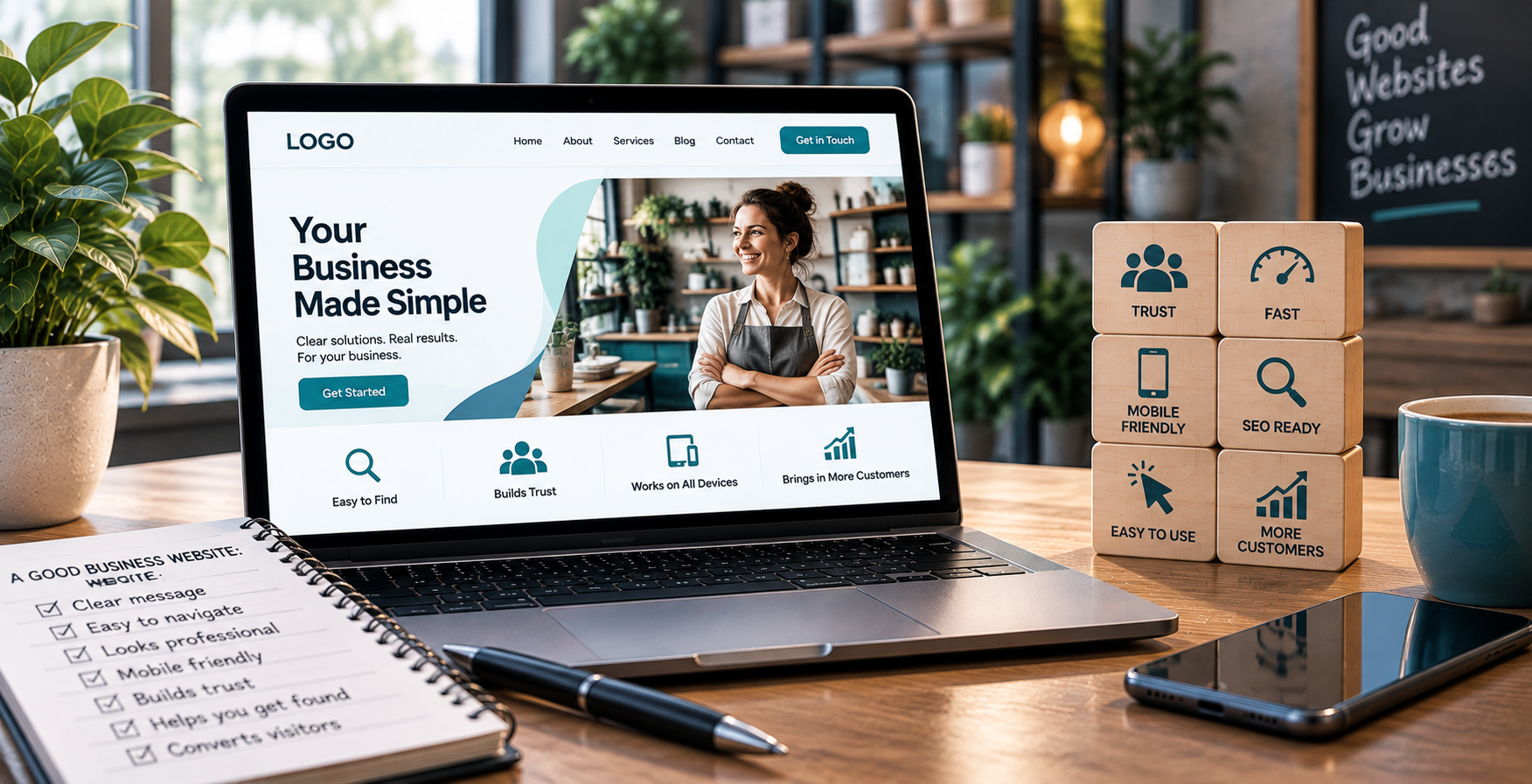
What Makes an Amazing Business Website?
A good business website needs to do more than look nice.
It needs to help the right person quickly work out who you are and what you offer. Then whether you can help them, and what to do next.
Sounds simple. It’s also exactly where lots of business websites quietly fall apart.
One site has gorgeous photos, polished branding and clever animations, yet visitors still hunt for the phone number. Another has everything a customer needs, buried so deep in clutter that nobody knows where to look.
A good business website brings design, content, ease of use, search visibility and trust together. Here’s what that looks like in practice.
1. A Good Business Website Makes Your Offer Immediately Clear
Picture someone landing on your website for the first time. Within a few seconds, can they answer these questions?
- What does this business do?
- Who is it for?
- Where does it work?
- What should I do next?
If not, your homepage may be trying to sound clever instead of being useful.
Your main heading and opening lines should say what you offer, plainly. For example, “Search Visibility & Digital Growth for UK Businesses” is far more useful than “Creating Digital Possibilities for Tomorrow”.
The second one sounds lovely. It also leaves the visitor doing the detective work, without the cool hat. Clear beats clever, nearly every time.
2. The Website Is Built Around the Customer, Not the Business
A common mistake is organising a website around how the business thinks internally.
Customers don’t think in departments. They think in problems. They might be wondering:
- Why isn’t my website showing up on Google?
- Can someone build me a better website?
- How do I get more local customers?
- Why is my competitor showing up above me?
- Can my business appear in AI search?
A strong website walks visitors from their problem to your solution. They shouldn’t need to learn your internal jargon first.
So your menu, headings, service pages and buttons should reflect the questions your customers are actually asking.
3. It Has Simple, Logical Navigation
Nobody should need a treasure map to find your services.
Good navigation keeps the main choices obvious. For a service business, that might be: Home | Services | About | Resources | Contact.
Your Services section can then lead to each individual service.
Important pages should also link to each other naturally. Someone reading an article about website problems might be pointed to your Web Development service. Someone learning about search visibility could carry on to your SEO Services.
That helps visitors explore, and it gives your website a clearer structure.
4. Your Website Works Properly on Mobile
A good business website can’t be designed only for a big desktop screen.
People find you from the sofa, on the train, or while comparing businesses on their phone before they call. So your mobile site should feel designed for phones, not like a desktop site squeezed into a smaller rectangle.
Check:
- Can visitors read the text comfortably?
- Are buttons easy to tap?
- Does the menu work properly?
- Do images fit the screen?
- Are forms easy to fill in?
- Is important information visible without endless scrolling?
- Are pop-ups getting in the way?
Google also suggests looking at the overall page experience rather than obsessing over one number.
The goal isn’t just to keep Google happy. It’s to make the website pleasant and practical for the person holding the phone.
5. Pages Load Without Making People Fight the Website
Speed matters.
Visitors shouldn’t have to watch half a page rearrange itself, or wait for giant images, videos and scripts to turn up.
Slow pages can come from lots of places. Think oversized images, plugins you don’t need and poor hosting. Or too many scripts, heavy page builders and clunky design features.
That doesn’t mean chasing a perfect speed score. A better question is: does the website feel fast, stable and easy to use for real visitors?
If the honest answer is “not really”, it’s worth finding out why.
6. The Content Answers Real Customer Questions
A good business website isn’t all sales copy.
Your service pages explain what you sell. Your other content helps people understand the problem, compare options and decide. That’s where articles, guides, FAQs and resources earn their keep.
For example, a potential SEO client might first search “What does SEO actually do?”
Later, “How much does SEO cost?”
Eventually, “Which SEO agency should I choose?”
Those are different stages of the same buying journey. Useful content lets you help at every stage.
Google’s guidance keeps stressing content made for people, not content made to game rankings. So don’t ask “How many keywords can we squeeze in?” Ask: “Will someone leave this page clearer than they arrived?”
That’s a much healthier starting point.
7. Each Page Has a Clear Purpose
Every important page should have a job.
- Your homepage introduces the business.
- A service page explains one service and invites the next step.
- An About page builds confidence in the people behind it.
- An article answers a specific question.
- A Contact page makes getting in touch easy.
Trouble starts when one page tries to do everything. You end up with company history, every service, ten testimonials and an FAQ. Then every blog post, every badge and a small autobiography, all before the contact button.
Give each page one clear purpose and let the rest of the website do the rest.
8. Calls to Action Tell Visitors What to Do Next
Never assume people will just know what you want them to do. Tell them.
Depending on the page, your next step might be:
- Request an SEO Audit
- Get a Quote
- Book a Consultation
- View Our Services
- Read the Guide
- Contact Us
The right one depends on how close the visitor is to deciding.
Someone reading an introductory article might not be ready for a proposal. They might just want another helpful guide. Someone on a service page is probably much closer. Good design respects that difference.
9. It Gives People Reasons to Trust the Business
Visitors are making small trust decisions all the time.
Is this company real? Do they get what I need? Can I contact them? Do they explain what they actually do? Does the website feel current?
Good trust signals include genuine testimonials, case studies, clear contact details and an About page. A plain explanation of your process, professional branding and proof of experience help too.
The key word is genuine.
A website doesn’t become trustworthy by covering every space in badges and lines like “We are the UK’s number one award-winning industry-leading experts”.
Only say what you can back up. Specific is far more convincing than hype.
10. Important Business Information Is Easy to Find
Nobody should have to dig through five pages for your contact details.
Depending on your business, make these easy to spot:
- email address
- phone number
- service area
- opening hours
- location
- enquiry form
- social profiles
Local businesses should keep their business and location details consistent everywhere online.
If you work remotely, say clearly which areas or markets you cover.
11. The Website Supports Search Visibility From the Beginning
SEO shouldn’t be bolted on six months after launch, like an emergency spare wheel.
Your structure, page topics, menu, content and technical set-up all affect how easily search engines can find and understand your site.
That doesn’t mean designing purely for Google. Quite the opposite. Most sensible SEO basics make websites easier for humans too:
- clear page topics
- logical navigation
- descriptive headings
- useful content
- fast, secure pages
- helpful internal links
- good mobile experience
If being found matters to your business, bring SEO into the planning stage. It can save a costly rebuild later.
You can read more about how we approach SEO Services.
12. The Website Is Designed to Support a Business Goal
This might be the most important point of all.
A website isn’t a success just because it exists. Ask what you actually need it to do.
For one business, it’s enquiries. For another, it’s online sales. Another needs bookings. Another mainly needs to look credible before prospects speak to the team.
Once the goal is clear, you can design around it. It shapes your menu, page structure, buttons, content, forms, landing pages and even what sits at the top of each page.
13. Privacy and Cookie Requirements Haven’t Been Forgotten
A professional website also needs to think about how visitor data is handled.
If your UK business collects personal details, like names and emails through an enquiry form, you’ll generally need clear privacy information.
If your website uses cookies or similar technology, you also need to follow the UK rules. That covers how you tell visitors and when you need their consent. The ICO’s cookie guidance explains it.
It’s one of the less glamorous bits of building a website. But ignoring it because it doesn’t match the colour palette isn’t a great plan.
A Simple Good Business Website Test
Forget design awards for a moment.
Open your website and pretend you know nothing about the business. Can you quickly tell:
- What the business does?
- Who it helps?
- What services are available?
- Why you should trust it?
- Where it operates?
- How to learn more?
- How to get in touch?
Now try the same thing on your phone.
If any of those answers are hard to find, congratulations: you’ve just found your first improvement.
Does a Good Business Website Need to Be Complicated?
No.
Often, simpler websites do a better job because visitors understand them quickly.
A small business doesn’t automatically need dozens of pages, fancy animations or every new design trend. It needs the right pages, arranged sensibly, with useful information.
As your business grows, the website can grow with it. That might mean adding service pages, industry pages, location pages, resources, online shopping or more advanced features later.
Good structure leaves room for that growth without overcomplicating things now.
Do You Need a Web Design Agency?
Not every business needs an agency.
A very small business with simple needs might start with a well set-up website platform or template.
A web design agency earns its fee when the project needs strategy, a custom structure or technical know-how. The same goes for search planning, integrations, online shopping or a site built around a wider growth plan.
Before choosing one, look beyond the portfolio. Ask:
- What’s included?
- Who writes the content?
- Is SEO considered during the build?
- Who owns the website?
- What happens after launch?
- How are changes handled?
- What support is available?
A beautiful portfolio is useful. A clear process is better.
What Makes a Good Business Website in the End?
A good business website isn’t about one feature. It’s several things working together:
- clear messaging
- useful content
- good structure
- a great mobile experience
- strong performance
- trust
- search-friendly foundations
- straightforward next steps
Most importantly, it comes from understanding what your customer actually needs from the website.
Your website shouldn’t make customers work hard to understand you. It should make choosing you easier.
Is Your Website Doing Its Job?
Maybe your website looks fine but is hard to find, confusing to use or out of date. If so, it may be time to look beyond the design.
At BW Digital, we build search-focused websites with structure, ease of use and future visibility planned in from day one.
Not sure where to start? Our free homepage audit tells you, in plain English, what’s working and what to fix first. It’s back within 1–2 working days. Or explore our Web Development services.
🌐 bwdigital.co.uk
Share this article
Latest articles
November 3, 2026
November 3, 2026
November 3, 2026
A quick overview of the topics covered in this article.