
How to Get to the Top of Google Search
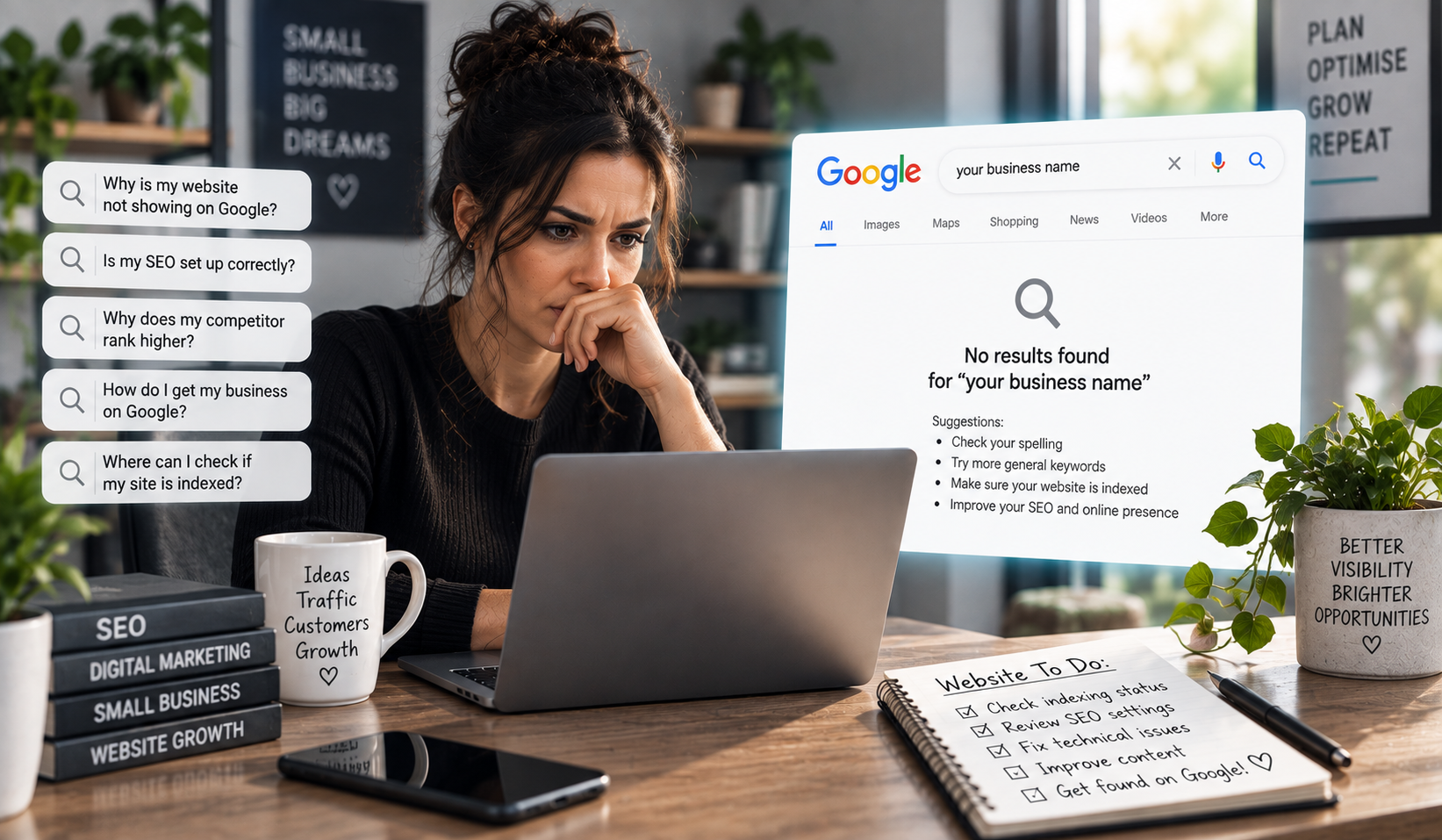
So you want to know how to get to the top of Google search? You type in what your business offers.
Your competitors appear.
You scroll.
And scroll.
Your business is nowhere to be seen.
It’s frustrating, especially when you know you offer exactly what that person is looking for. You’re not alone, and it’s usually fixable.
Before asking how to get to the top, there’s a more useful question. Is your website actually missing from Google? Or is it there, just ranking lower than you’d like?
Those are two very different problems.
If Google can’t crawl or index your website, there may be a technical issue. If it’s indexed but sits far below competitors, the problem is more likely relevance, content, authority, structure or competition.
Google itself says being in its index doesn’t guarantee a page will rank well for a particular search. Its systems weigh up relevance, quality and many other factors.
So before throwing more keywords at the problem, let’s work out why you’re being overlooked.
First: Is Your Website Missing or Just Ranking Poorly?
This is the quickest thing to work out.
Search for your business name. If your website doesn’t appear at all, there may be an indexing or technical problem.
But say you search “accountant near me” and your website is several pages behind your competitors. Google probably knows your site exists. It just isn’t picking it as one of the best results for that search.
Google Search Console is far more useful here than Googling yourself every morning.
Its URL Inspection tool shows whether Google has indexed a page, whether crawling worked, and whether anything is blocking it.
Once you know which problem you have, the mystery becomes a lot less mysterious.
Here are ten common reasons your business might not be showing where you expect.
1. Google Hasn’t Found or Indexed Your Page Yet
Let’s start with the simplest one. Google can’t rank a page it hasn’t indexed.
Google finds most of the web automatically, using crawlers that follow links from page to page. So new websites and new pages can take a while to be found.
This is especially common when:
- your website is brand new
- a page has only just been published
- nothing else on your site links to the page
- your sitemap doesn’t include the new address
- Google hasn’t visited your site recently
It doesn’t necessarily mean anything is wrong.
Google says crawling and indexing take time and can’t be guaranteed within any set period. Even submitting a sitemap doesn’t guarantee indexing.
How do you know?
Check the page in Google Search Console’s URL Inspection tool.
If Google hasn’t found it, that’s a very different problem from a page that’s indexed but ranking poorly.
That’s why the first step is working out what’s wrong, not rewriting the page straight away.
2. Your Website May Be Accidentally Blocking Google
Sometimes Google can find your website just fine. It’s your website telling Google, “Please don’t include this page.”
That can happen through:
- a “noindex” tag
- robots.txt rules
- password protection
- a login wall
- the wrong website settings
It often happens after a redesign. The test site is rightly hidden from search engines while it’s being built. Then the “hide me” setting gets left on when the new site goes live.
Google specifically recommends checking robots.txt and “noindex” rules when a page isn’t showing up.
Why this one matters
You could have brilliant content, great branding and a beautiful website.
But if important pages can’t be indexed, Google has nothing it can show in search results.
That’s why technical SEO usually starts by checking access and indexing before touching the content.
There’s little point repainting the front door if Google can’t get through the gate.
3. Your Page Does Not Clearly Match What People Are Searching For
Now say your page is indexed. The next question is: why would Google pick it for this search?
Google looks for pages that match what the person asked. Its Search Essentials suggest using the words people search with in key places. That means page titles, main headings, image alt text and link text.
Take a business offering commercial cleaning in Birmingham. Its homepage might say: “Creating cleaner spaces through exceptional solutions.”
Perfectly pleasant. But it tells Google and visitors surprisingly little.
Compare that with: “Commercial Cleaning Services for Businesses in Birmingham”.
The second one instantly says what the service is, who it’s for and where it’s offered.
That doesn’t mean stuffing “commercial cleaner Birmingham” into every paragraph. It means making the page properly clear.
This is where many businesses go wrong
Websites often get written by people who already know the business inside out.
Google and first-time visitors don’t have that background. Your pages need to spell out what you actually offer.
4. Your Content May Not Be Strong Enough to Compete
This is where “why does my competitor rank higher?” becomes a useful question.
Open your page. Then open the pages ranking above it. Don’t just compare how pretty they are. Compare what the searcher gets from each one.
- Does your competitor explain the subject more fully?
- Do they answer questions you skip?
- Do they show more experience?
- Do they give examples?
- Is their page simply more useful?
Google says its ranking systems aim to reward helpful, reliable, people-first content. That means content with real value, not a rehash of what’s already out there.
That doesn’t mean every service page needs to become a 4,000-word essay. Google says it has no preferred word count.
A better question is: does this page give people enough to solve the reason they searched?
If your competitor does that better, adding another paragraph with your keyword in it probably won’t change much.
5. Your Website Structure Makes Important Pages Hard to Find
Google finds lots of pages by following links. So how your website is laid out matters.
Imagine you have an excellent service page, but it’s:
- not in your main menu
- not linked from related articles
- buried several clicks deep
- cut off from other useful pages
Google might still find it through your sitemap. But you’re not giving search engines or visitors a clear route to it.
Google’s SEO guidance explains that links are an important way it discovers new pages. Links between your own pages also show how they relate to each other.
For example, an article about SEO services might link to technical SEO, local SEO and AI search optimisation. It could also link to SEO audits and your main SEO service page.
Together, those links make your website easier to get around and understand.
Think of your website as a network, not a filing cabinet
Important pages shouldn’t sit alone, waiting for someone to stumble across them.
A sensible structure connects related information logically. That helps customers too.
6. Your Competitors May Simply Have Stronger Search Authority
Sometimes there’s no dramatic technical disaster. Your competitors simply have a stronger online presence.
Google learns about pages and businesses from across the web. Links between websites have long been part of how it finds and understands content.
A competitor might have:
- been online for longer
- earned more relevant press coverage
- picked up useful links naturally
- published stronger guides and resources
- built a bigger profile in their industry
- been mentioned by respected websites
- become known for their topic
That doesn’t mean you should rush out and buy hundreds of backlinks. Google’s spam policies ban link schemes designed to game rankings.
Real authority is built, not bought in a suspicious-looking spreadsheet for £29.99.
For most businesses, useful PR, really helpful content, partnerships and being active in your industry all build a healthier presence over time.
7. Poor Website Experience May Be Working Against You
SEO isn’t only about the words on a page. People need to be able to use the website too.
Google’s ranking systems look at signals linked to page experience, including Core Web Vitals. But Google is very clear there’s no single page experience score that guarantees rankings.
Things worth checking include:
- how fast pages load
- how well it works on phones
- whether the page jumps about as it loads
- how quickly it responds to taps and clicks
- HTTPS (the padlock)
- pop-ups that get in the way
- whether the main content is easy to use
A slow website won’t automatically vanish from Google. And a perfect speed score won’t suddenly launch a weak page to first place.
But when several good pages are competing, a clunky experience isn’t helping your case.
Google’s own advice is to think about the overall experience, not chase one technical score on its own.
8. You May Be Looking at a Local SEO Problem
For local businesses, “showing up on Google” can mean something slightly different.
You might rank in the normal results but barely appear in Google Maps or Google’s local business results. That’s where local SEO comes in.
Google says local results are mainly based on three things: relevance, distance and prominence.
It also recommends keeping your Business Profile verified, complete and accurate.
So when someone searches “dentist near me”, your website SEO is only part of the picture. Your Google Business Profile, location, category, reviews and wider local presence all play a part.
This matters especially for service businesses
A plumber, solicitor, restaurant or physio usually wants to be found by people within a realistic distance.
They don’t just need “more traffic”. They need to be visible to the right people, in the right places.
That’s why general SEO and local SEO often need to work together.
9. A Website Redesign or Migration May Have Created Problems
Did your visibility drop after launching a new website? That timing is worth a closer look.
Moving to a new website can cause SEO problems when:
- old addresses change without proper redirects
- pages disappear
- internal links break
- new pages are accidentally blocked
- canonical tags are wrong
- sitemaps still list old addresses
- important content gets removed
- HTTP and HTTPS versions are mixed up
Google’s migration guidance warns about mistakes like forgotten “noindex” rules, robots.txt blocks, wrong redirects and out-of-date sitemaps.
A new website can look much better while performing much worse in search. Like a shiny new shop that’s moved to a street with no signposts.
That’s why SEO should be part of the plan before, during and after a big website move. If your rankings vanished around the time of a redesign, that’s worth investigating.
10. Your Website Could Have a Manual Action or Security Problem
This is less common than the other reasons, but it matters.
Google may take a “manual action” when a human reviewer decides a website breaks its spam policies. Depending on the issue, some pages or even the whole site can drop or disappear from Google.
Security problems can also affect how your site appears. Hacked pages, malware or phishing can lead to warning labels or other restrictions.
The good news is you don’t have to guess. Google Search Console has dedicated Manual Actions and Security Issues reports.
If both are clear, you can move on and look at the more common causes.
So, How Do You Get to the Top of Google Search?
Time to clear up one stubborn SEO myth. There’s no checklist that guarantees the top spot.
Google itself says there are no secrets that will automatically rank a website first.
That doesn’t mean SEO is random. It means the answer depends on what’s currently stopping your website from competing.
For one business, the biggest issue is technical. For another, it’s weak service pages. Another has poor local visibility. Another is up against companies with much stronger content and authority.
That’s why copying a generic “30 SEO tips” list can waste a remarkable amount of time. The priorities need to match the problem.
Why Does My Competitor Rank Higher Than Me?
This is probably what business owners really mean when they ask why they’re not on Google.
And sadly, the answer is rarely “They used one secret keyword.”
More often, the competitor has a mix of strengths. They might have:
- more relevant pages
- better technical foundations
- clearer service information
- stronger internal linking
- more established authority
- better local visibility
- more useful content
- a better page experience
- a closer match for that particular search
Google says relevance depends on many factors. It can change with the search, the searcher’s location, their device and other context.
So there’s no single ranking order for everyone. Someone searching in London can see different results from someone in Leeds. A phone search can differ from a desktop one too.
Googling your favourite keyword over and over isn’t a complete way to measure things.
What Should You Check First?
If your business seems invisible on Google, resist the urge to change everything at once. Start with three questions.
1. Is Google indexing the page?
Use Search Console to see whether the page is in Google’s index.
If it isn’t, look at crawling and indexing first.
2. Is the page getting impressions?
Search Console’s performance report shows whether your pages appear in searches, even when they get few clicks.
If they’re getting impressions, the problem may be rankings, relevance or how appealing your listing looks, not total invisibility.
3. Are the right pages competing for the right searches?
Sometimes a business has plenty of pages but no clear page for an important service.
Other times, several pages compete for the same topic.
That’s where a wider SEO review is more useful than staring at one keyword.
How Long Does It Take to Improve Google Rankings?
SEO usually takes patience.
Google says some changes can show within hours, while others can take several months. It generally suggests waiting at least a few weeks before judging whether a change has helped.
So if someone promises “Number one on Google in seven days”, feel free to raise an eyebrow.
How long it takes depends on your competition, your website’s current state, how big the changes are and how quickly Google revisits your pages.
A new business competing nationally for a tough search faces a very different journey from an established local business targeting one service area.
Can You Pay Google to Rank Higher Organically?
No. Ads and organic rankings are completely separate.
Google says it doesn’t accept payment to rank pages higher in its organic (unpaid) results.
You can pay for Google Ads to appear in sponsored spots. That’s advertising. SEO is about improving your visibility in the unpaid results.
Be very wary of any agency claiming a special relationship with Google that lets them buy organic rankings. That’s not how organic search works.
When Might You Need SEO Help?
You don’t need an agency every time one page slips a position.
But professional SEO services can help when:
- you can’t tell whether Google is indexing your important pages
- your rankings have dropped a lot
- competitors keep outranking you
- your website has technical problems
- you’ve recently moved to a new website
- your local visibility is poor
- you have lots of content but little traffic from Google
- you don’t know which problems to fix first
A good SEO provider should explain why something needs changing. Not send you a mysterious report with 847 warnings and disappear into the fog.
Whether you work with a consultant or an agency, the plan should start with your actual visibility problem.
Being on Google and Being Competitive on Google Are Different Things
This is the most useful thing to take away.
A website can be crawled, indexed and visible somewhere in Google, and still bring in almost no useful traffic.
Being in Google’s index is only the starting line. Your pages then need to be relevant, useful, accessible and competitive for the searches that matter to your business.
So if you’re wondering how to get to the top of Google search, try a slightly better question. What’s stopping the right customers from finding my business?
Once you know that, you can stop guessing. And start fixing what actually matters.
Can’t Work Out Why Your Business Is Being Outranked?
If your website exists but competitors seem to own the search results, there’s usually more going on than one missing keyword.
At BW Digital, we look at the whole search picture. That includes technical SEO, content, website structure, local SEO, competitors and the searches that actually matter to your business.
The aim isn’t another SEO checklist. It’s finding where you’re losing visibility, and what’s realistically worth fixing first.
Before you can improve your position on Google, you need to know what’s holding you back. Our free homepage audit is a good place to start. It’s in plain English and back within 1–2 working days.
Frequently Asked Questions
Why Isn’t My Website Showing Up on Google?
Google may not have found or indexed it yet, indexing may be blocked, or the page may not match the search well enough. Stronger competing pages may also be ranking above it. Google Search Console can show whether the page is indexed.
How Do I Check Whether Google Has Indexed My Website?
Use the URL Inspection tool in Google Search Console for an individual page. A “site:” search gives a quick indication, but Google notes it doesn’t always show every indexed page.
How Do I Get to the Top of Google Search?
There’s no guaranteed way to reach the number-one organic position. Improving technical access, relevance, content, structure, authority and user experience can strengthen your visibility. Rankings still depend on the search and the competition.
Why Does My Competitor Rank Higher Than Me?
A competitor may have more relevant content, stronger authority, better technical SEO, a clearer structure or stronger local SEO. Often it’s a combination. Google uses many systems and signals to judge relevance and quality.
Can Google Take Time to Find a New Website?
Yes. Crawling and indexing take time, especially for new websites or pages. Google says there’s no guaranteed timetable for when a page will be crawled or indexed.
Does Having a Sitemap Guarantee Google Rankings?
No. A sitemap helps Google find your pages, but Google says submitting one doesn’t guarantee indexing or improve rankings by itself.
Can Poor Website Speed Stop Me Ranking?
A poor page experience can hold you back, but speed isn’t a switch that decides rankings on its own. Google recommends good Core Web Vitals while also stressing overall experience and relevant content.
Why Isn’t My Business Showing in Google Maps?
Local results are mainly based on relevance, distance and prominence. An incomplete or unverified Business Profile, your location, competition and wider local signals can all affect visibility.
Can I Pay Google to Rank My Website First?
You can pay for Google Ads, but you can’t buy a higher organic ranking from Google. Organic results are ranked separately from ads.
Should I Hire an SEO Agency If My Website Is Not Ranking?
Not automatically. First work out whether the issue is indexing, technical SEO, content, competition, local SEO or something else. Professional help is most useful when you can’t confidently diagnose or prioritise the problems.
Share this article
Latest articles

November 4, 2026
November 4, 2026

November 4, 2026
A quick overview of the topics covered in this article.