
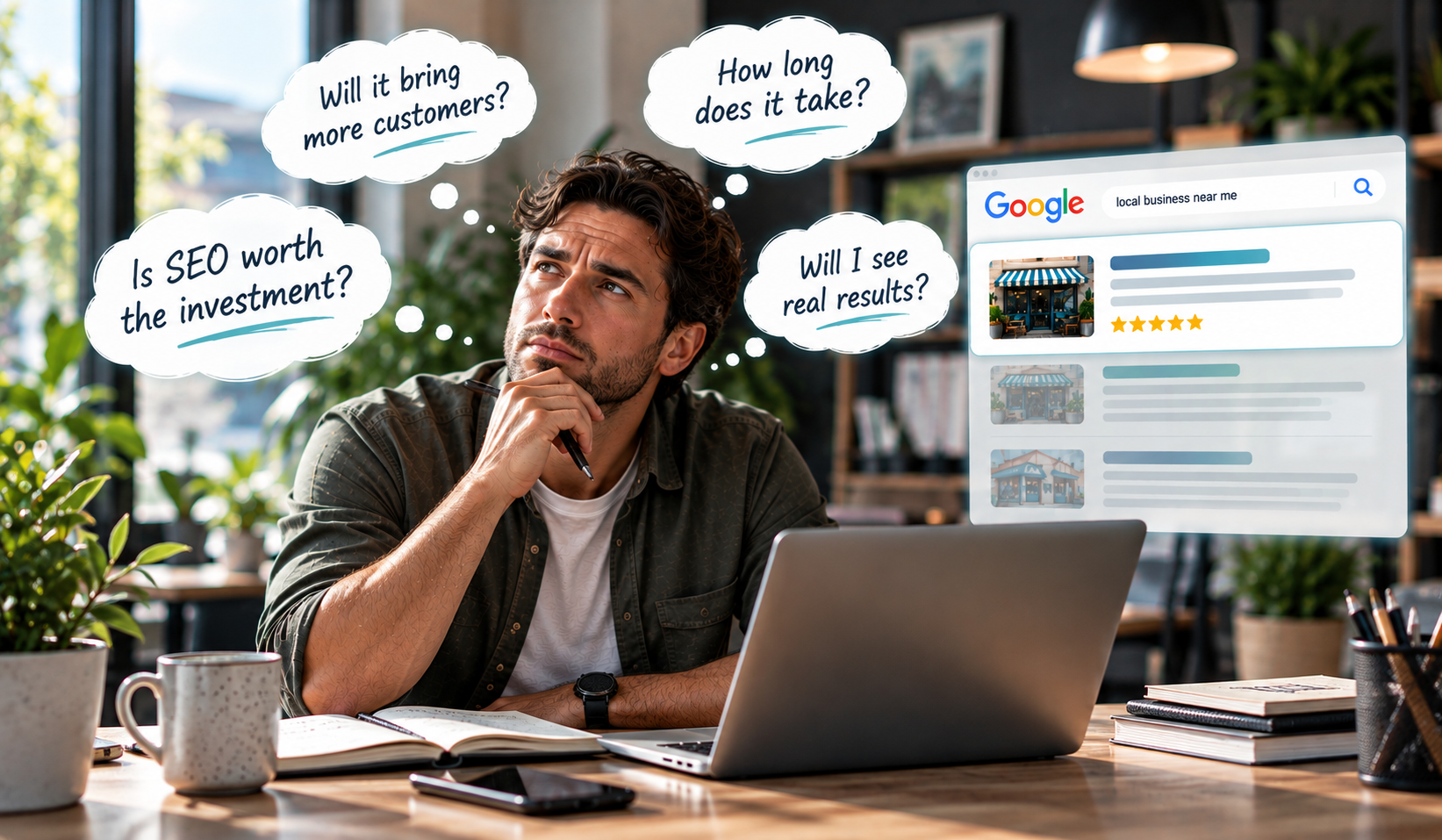
Is SEO Worth It for a small business? A Practical Guide
Is SEO worth it for a small business?
For many businesses, yes. But only when it supports a real business goal and you go in with realistic expectations.
SEO can make your business easier to find when people search for what you sell or know. That doesn’t mean every business should throw money at it straight away. And paying an agency doesn’t automatically mean results.
Whether it’s worth it depends on your market, competition, website, budget, goals and how your customers search.
So before you spend a penny, it helps to know what SEO can do, what it can’t, and when it makes business sense.
What Does SEO Actually Do for a Small Business?
SEO (search engine optimisation) makes it easier for search engines to find, understand and rate your website.
For a small business, that might mean:
- improving your website’s structure
- finding out what your customers search for
- creating useful service pages and guides
- improving individual pages
- fixing technical problems
- improving your local visibility
- building trust and authority
- keeping an eye on how you’re performing
- improving the website over time
The goal isn’t just “more traffic”. Good SEO brings you more of the right visitors.
Ten people looking for exactly what you offer can be worth far more than hundreds who were never going to buy.
So, Is SEO Worth It for a Small Business?
SEO can be worth it when your customers already use search to find businesses like yours.
Think of a plumber, accountant, solicitor, web designer, restaurant, dentist or online shop. Their customers might search things like:
- “plumber near me”
- “accountant for small business”
- “SEO agency UK”
- “website design company”
- “dentist near me”
- “buy [product] online”
If people already search for what you do, being visible puts you in front of them right when they’re deciding.
That’s where SEO gets interesting. You’re not interrupting someone who doesn’t care. You’re showing up when they’re already looking.
When Is SEO Most Worth It for a Small Business?
SEO tends to make most sense when several of the following are true.
Your Customers Search Online for What You Offer
This is the first question to ask.
If your customers regularly use Google or other search tools to find businesses like yours, SEO probably deserves a place in your marketing.
Keyword research can show you:
- what people search for
- how often they search for it
- what questions they ask
- whether they’re ready to buy
- how competitive those searches are
That’s why good SEO starts with research, not with randomly changing pages.
You Want More Consistent Search Visibility
Paid ads give you visibility while you’re paying for them. SEO works differently.
The aim is to build pages and authority that keep bringing in the right visitors over time.
That doesn’t mean rankings last forever. Competitors change. Search engines change. Websites change. Customers change. So SEO needs ongoing care.
But unlike an ad that vanishes the day the budget stops, useful pages can keep working long after they’re published.
Your Competitors Are Already Visible
Sometimes the clearest sign is seeing your competitors pop up again and again for searches that should be yours.
If customers search for your service and keep seeing other businesses first, those competitors are getting chances you’re missing.
That doesn’t mean you should copy them. Competitor research helps you answer:
- What searches do they show up for?
- Which of their pages rank?
- What questions are they answering?
- How is their website laid out?
- Where are the gaps?
- Where could you do something better?
SEO isn’t about chasing competitors around. It’s about understanding the field you’re playing on.
You Sell a Service With Strong Customer Value
SEO is easier to justify when each new customer is worth a good amount to you.
For example, imagine one new enquiry becomes a customer worth £1,000, £5,000 or more over the time they stay with you. (That’s just an illustration. Use your own numbers.)
In that case, SEO doesn’t need to bring in hundreds of customers a month to pay its way. A handful of the right enquiries could make it worthwhile.
That’s why judging SEO on traffic alone can mislead you. Better questions are:
- Are the right people finding us?
- Are they doing something useful when they arrive?
- Are those enquiries turning into customers?
Is SEO Worth It for a Small Business With a Small Budget?
It can be. But the plan needs to fit the budget.
A small business usually shouldn’t try to beat huge national brands for every keyword going. A more focused plan might target:
- specific services
- local searches
- less competitive opportunities
- customer questions
- your niche expertise
- useful supporting content
- particular areas you serve
That’s usually smarter than spreading a small budget thinly across dozens of unrelated tasks.
Affordable SEO should mean focused, sensible SEO that suits your business. It shouldn’t mean cutting so many corners that nothing useful gets done.
Affordable SEO vs Cheap SEO
There’s an important difference here.
Affordable SEO services are built around what your business realistically needs and can keep up.
Cheap SEO can mean:
- automated content
- poor-quality backlinks
- generic monthly reports
- no real strategy
- very little technical work
- no understanding of your business
- activity designed to look busy rather than achieve anything
You don’t need the biggest SEO package going. You need the right work, in the right order.
Sometimes fixing five important problems is worth more than fifty low-value tasks.
How Long Does SEO Take for a Small Business?
SEO is rarely instant. How fast you see progress depends on things like:
- your current website
- how competitive your market is
- your website’s history
- technical problems
- existing authority
- the quality of your content
- local competition
- the keywords you’re targeting
- how much work is needed
Some improvements can show fairly quickly. More competitive goals can take much longer.
So be wary of anyone promising guaranteed rankings by a certain date. A good SEO provider explains what they’re prioritising, what they’re measuring and what’s realistic.
Is SEO Better Than Google Ads for a Small Business?
It doesn’t have to be one or the other. SEO and paid ads solve different problems.
Google Ads can get you seen quickly for chosen searches, for as long as you keep paying. SEO builds your unpaid visibility over time.
Plenty of businesses use both. For example:
- Google Ads can bring in visitors while a newer website builds its search presence.
- SEO can build longer-term visibility through stronger pages, content and foundations.
Which makes more sense depends on your goals, your budget and how quickly you need results.
What About Local SEO?
If you serve a particular area, local SEO might be one of the most valuable parts of search for you.
Someone searching for a nearby service usually means business. They’re not researching the history of plumbing. They need a plumber. Ideally before the kitchen floods.
Local visibility can involve:
- your Google Business Profile
- Google Maps
- local pages on your website
- consistent business details
- reviews
- local relevance
- website improvements
Google says local results are mainly based on relevance, distance and prominence. So for local businesses, your whole online presence matters, not just the website.
What About AI Search?
Search is also spreading beyond the classic Google results.
More and more people use AI search and answer tools to research businesses, compare services and ask detailed questions.
That doesn’t make normal SEO pointless. Many of the same basics still help: clear services, well-organised information, useful content, real expertise and a strong online presence.
For small businesses, the goal isn’t chasing every new AI trend. It’s making your business easy to understand, wherever people search.
When Might SEO NOT Be Worth It?
SEO isn’t automatically the best investment for every business. It might not be your first priority if one of these applies.
Nobody Searches for What You Sell
Some very specialised or brand-new products have hardly any search demand yet.
If nobody’s searching, you may need to create demand first, through other channels.
You Need Customers Immediately
If you need leads this week, SEO on its own probably isn’t the answer.
Paid ads, direct outreach or other marketing can get you seen faster while SEO builds in the background.
Your Website Cannot Convert Visitors
Sending more people to a confusing, outdated or broken website won’t fix the real problem.
Sometimes the website needs attention before you send more people to it.
You Cannot Sustain the Investment
SEO works best as an ongoing part of your business, not a one-month experiment.
If the budget disappears after four weeks, it’s hard to build any real momentum.
There Is No Clear Business Goal
“Get more traffic” isn’t a full strategy. SEO should support something useful, such as:
- enquiries
- sales
- bookings
- calls
- shop visits
- people discovering your brand
- good-quality leads
If nobody knows what success looks like, it’s almost impossible to say whether SEO was worth it.
How Do You Know Whether SEO Is Working?
This is one of the most important questions you can ask. Don’t judge SEO on one number.
Useful things to measure include:
- visibility for relevant keywords
- visits from organic search
- enquiries
- calls
- form submissions
- bookings
- sales
- local visibility
- how your landing pages perform
- conversion rate
- revenue linked to organic search
Rankings are useful. Traffic is useful. But neither one automatically means business success.
Ranking number one for a search nobody useful types is a bit like winning a raffle you didn’t enter. Nice, but it doesn’t pay the bills.
Is Hiring an SEO Agency Worth It for a Small Business?
Sometimes.
A small business SEO agency makes sense when you don’t have the time, know-how or people to manage SEO yourself.
An agency can give you access to skills like:
- technical SEO
- keyword research
- content strategy
- on-page optimisation
- local SEO
- reporting
- competitor research
- website strategy
But hiring an SEO agency doesn’t mean you can stop understanding what you’re buying. Ask:
- What exactly will you work on?
- Why do those priorities matter?
- How will you measure progress?
- What reports will I get?
- What happens in the first few months?
- Who actually works on my account?
- What do you need from me?
Avoid providers who hide behind jargon or promise guaranteed rankings.
You don’t need to become an SEO expert. But you should know where your money’s going.
What About Hiring an SEO Consultant?
An SEO consultant can suit a business that already has marketing or web people in-house, but needs expert direction.
A consultant might provide:
- an SEO audit
- a keyword strategy
- website recommendations
- technical priorities
- a content plan
- competitor research
Your own team then puts the recommendations into action.
Whether you choose an agency, a consultant or do it in-house depends on how much help you actually need.
How Much Should a Small Business Spend on SEO?
There’s no single right number. A sensible SEO budget depends on:
- competition
- location
- website size
- current performance
- the services you’re targeting
- technical condition
- how much content you need
- your business goals
Instead of starting with “What’s the cheapest SEO package?”, start with “What work does my business actually need?”
Then weigh the cost of that work against what more of the right customers could be worth. That’s a far more useful way to think about it.
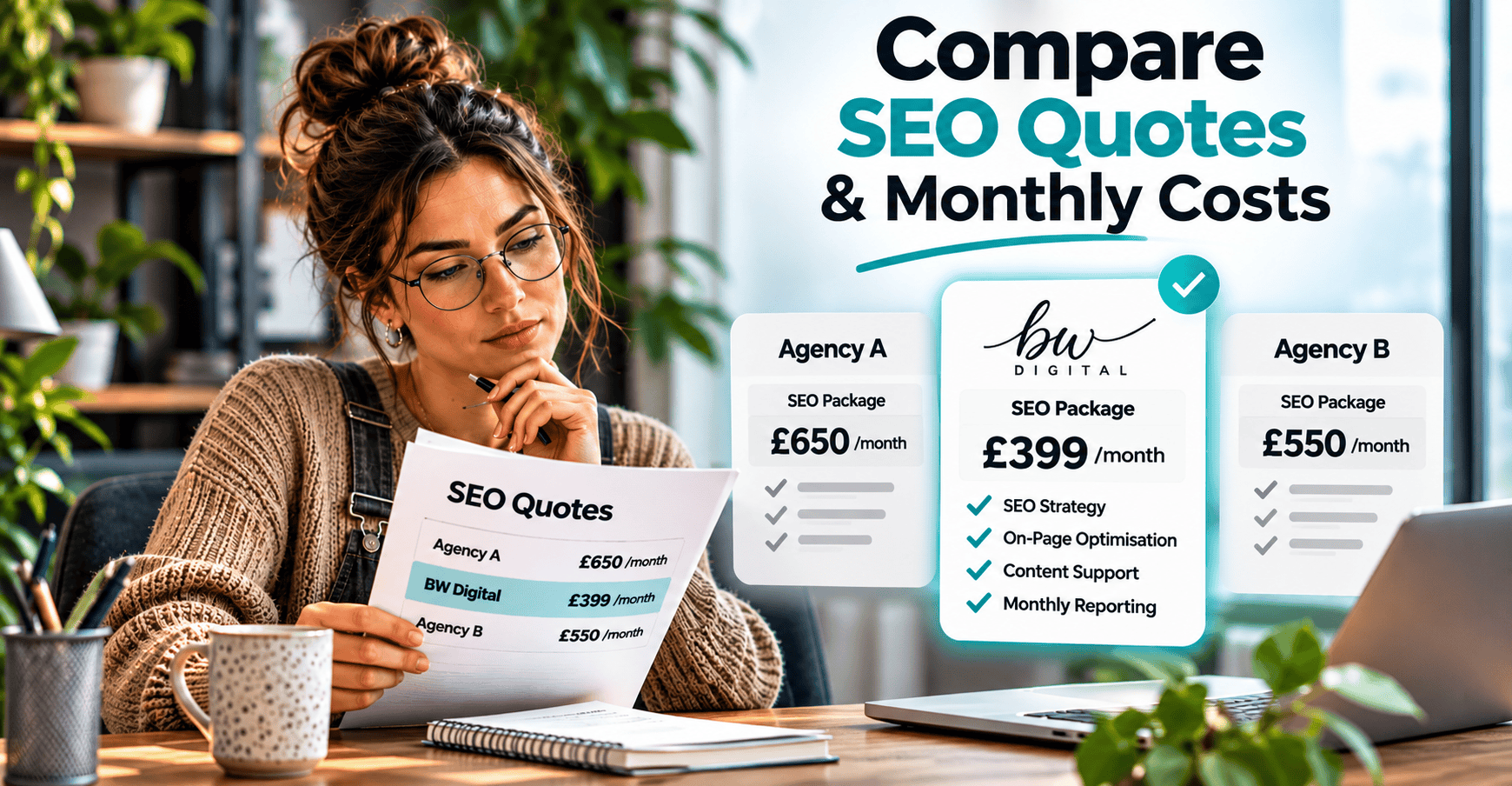
For transparency, our monthly packages start at £400 for 8 hours (Essentials), with Growth at £800 and Full Visibility at £1,200. All are rolling monthly with 30 days’ notice, and you own everything.
Questions to Ask Before Investing in SEO
Before spending money, ask yourself:
- Do potential customers search for what I offer?
- Am I showing up for those searches right now?
- Are competitors getting customers from search?
- What is one new customer worth to my business?
- Does my website make it easy to enquire or buy?
- Can I invest steadily rather than expecting instant results?
- Do I know what success looks like?
If your answers point to real search demand and a real opportunity, SEO is worth exploring.
Is SEO Worth It for a Small Business in 2026?
For the right business, yes. People still use search to find, research and compare businesses.
But SEO in 2026 is about more than a handful of blue links. Search now covers websites, local results, content, Google Business Profiles and, increasingly, AI search tools.
The basics are refreshingly practical:
- Be clear about what you offer.
- Create useful information.
- Build a website people can actually use.
- Make your business easy to understand.
- Show real expertise.
- Fix what isn’t working.
- Check the work is helping your business.
That’s worth far more than chasing every algorithm rumour that pops up on social media. Most of them have the shelf life of a banana.
So, Is SEO Worth It for a Small Business?
Is SEO worth it for a small business?
It can be, especially when customers already search for what you provide, and being more visible could bring in valuable enquiries or sales.
But SEO isn’t worthwhile just because somebody sells you a package. The plan has to fit:
- your business
- your customers
- your competition
- your budget
- your website
- your goals
Good SEO makes your business easier to find when the right customers are looking. And you should always be able to understand what’s being done to get there.
Want to Find Out Whether SEO Makes Sense for Your Business?
BW Digital provides practical SEO services for businesses that want clearer visibility, without the fog of mystery tasks and empty promises.
The easiest first step is our free homepage audit. We’ll show you, in plain English, where your website stands and what’s worth doing first. It’s back within 1–2 working days. You can also explore our SEO Services.
🌐 bwdigital.co.uk
Share this article
Latest articles
November 4, 2026
November 4, 2026
November 4, 2026
A quick overview of the topics covered in this article.