
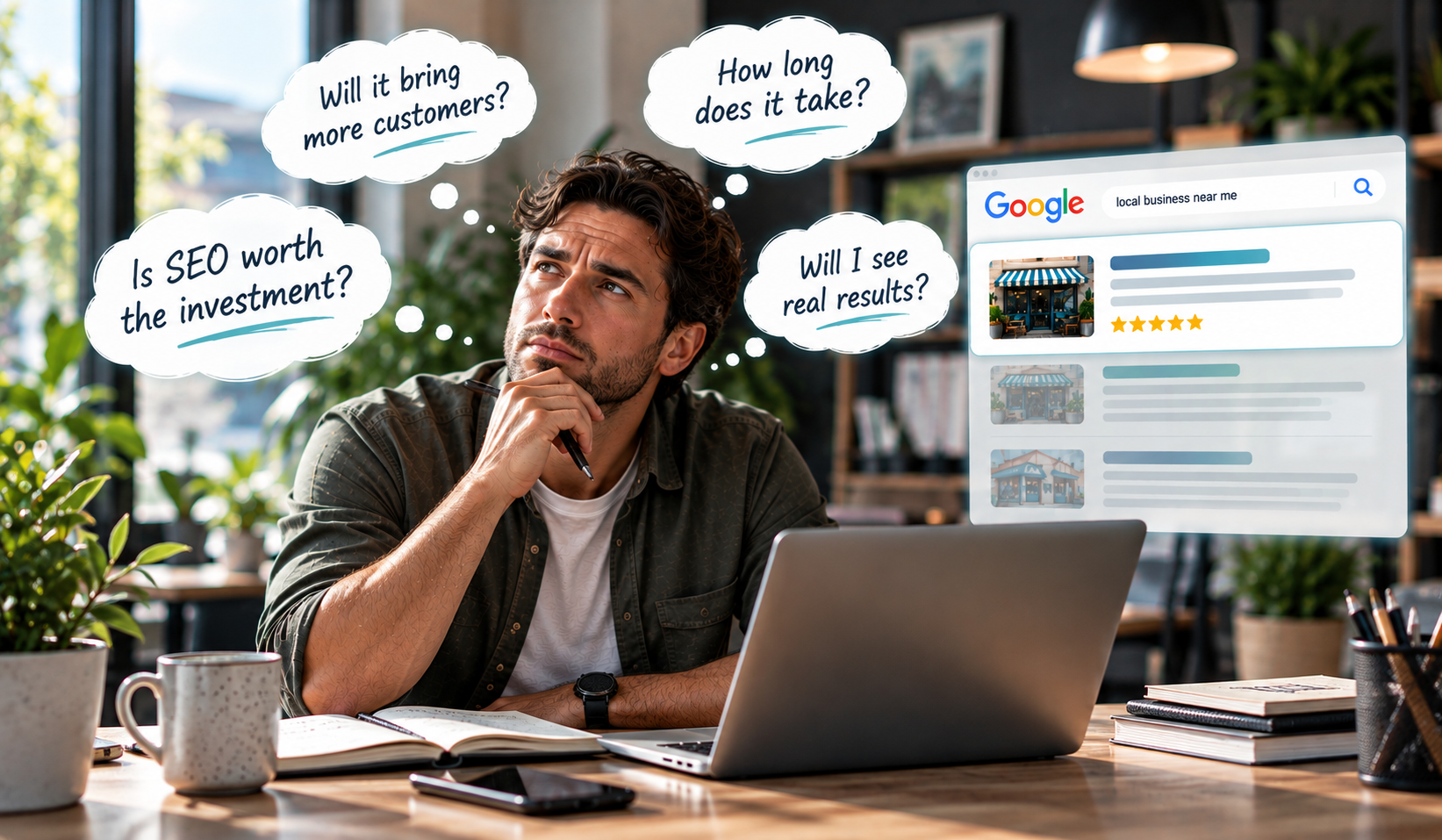
Is SEO Worth It for a small business? A Practical Guide
Is SEO worth it for a small business?
For many businesses, yes, but only when SEO supports a real business goal and is approached with realistic expectations.
SEO can help a small business become easier to find when potential customers search for its products, services or expertise. But that does not mean every business should immediately invest heavily in SEO, nor does it mean paying an agency automatically guarantees results.
Whether SEO is worth it depends on your market, competition, website, budget, goals and how your customers search.
So before investing, it helps to understand what SEO can realistically do, what it cannot do and when it makes commercial sense.
What Does SEO Actually Do for a Small Business?
SEO, or search engine optimisation, is the process of improving how easily search engines can understand, access and evaluate your website.
For a small business, that may involve:
- improving website structure
- researching what potential customers search for
- creating useful service and informational content
- improving individual pages
- fixing technical website issues
- improving local search visibility
- building authority and trust signals
- monitoring search performance
- improving the website over time
The goal is not simply to generate more website traffic.
Good SEO should help bring more relevant visitors to your website.
Ten people looking for exactly what you offer may be far more valuable than hundreds of visitors who have no intention of becoming customers.
So, Is SEO Worth It for a Small Business?
SEO can be worth it for a small business when your customers actively use search to find businesses like yours.
Consider a plumber, accountant, solicitor, web designer, restaurant, dentist or ecommerce business.
Potential customers may search things such as:
“plumber near me”
“accountant for small business”
“SEO agency UK”
“website design company”
“dentist near me”
“buy [product] online”
If people are already searching for the service you provide, improving your visibility can create an opportunity to appear during an important part of their decision-making process.
That is where SEO becomes commercially interesting.
You are not interrupting someone who has no interest in your service.
You are trying to become visible when they are already looking.
When Is SEO Most Worth It for a Small Business?
SEO tends to make the most sense when several of the following are true.
Your Customers Search Online for What You Offer
This is the first question to ask.
If your potential customers regularly use Google or other search experiences to find your type of business, SEO may have a meaningful role in your marketing.
Keyword research can help identify:
- what people search for
- how often certain topics appear
- what questions customers ask
- whether searches have commercial intent
- how competitive those searches are
This is one reason a good SEO strategy should begin with research rather than immediately changing pages.
You Want More Consistent Search Visibility
Paid advertising can provide visibility while campaigns are running.
SEO works differently.
The aim is to build pages and website authority that can continue attracting relevant search visibility over time.
That does not mean rankings are permanent.
Competitors change.
Search engines change.
Websites change.
Customer behaviour changes.
SEO therefore usually requires ongoing monitoring and improvement.
But unlike a campaign where visibility may disappear as soon as the advertising budget stops, useful website content and well-optimised pages can continue contributing value after they are created.
Your Competitors Are Already Visible
Sometimes the clearest sign that SEO matters is seeing your competitors appear repeatedly for searches relevant to your business.
If potential customers search for your service and consistently see competing companies before they see you, those competitors are gaining opportunities that your business may be missing.
That does not mean you should copy them.
Competitor research should help answer:
- What searches are they visible for?
- Which pages are ranking?
- What questions are they answering?
- How is their website structured?
- Where are the gaps?
- Where could your business provide something better?
SEO is not just about chasing competitors.
It is about understanding the search landscape you are competing within.
You Sell a Service With Strong Customer Value
SEO becomes easier to justify when a new customer has meaningful value to the business.
Imagine one new enquiry becomes a customer worth £1,000, £5,000 or considerably more over their lifetime.
In that situation, SEO does not necessarily need to generate hundreds of customers every month to contribute commercially.
A smaller number of highly relevant enquiries may make the investment worthwhile.
That is why judging SEO purely by website traffic can be misleading.
The better questions are:
Are the right people finding us?
Are they taking useful actions?
Are those enquiries turning into customers?
Is SEO Worth It for a Small Business With a Small Budget?
Potentially, yes.
But the strategy needs to match the budget.
A small business usually should not try to compete with enormous national brands for every possible keyword.
A more focused strategy may target:
- specific services
- local searches
- lower-competition opportunities
- customer questions
- niche expertise
- useful supporting content
- particular geographic areas
This is often more sensible than spreading a small budget across dozens of unrelated SEO activities.
Affordable SEO should mean focused, appropriate and commercially sensible SEO.
It should not mean cutting so many corners that nothing meaningful is actually being done.
Affordable SEO vs Cheap SEO
There is an important difference.
Affordable SEO services should be designed around what a business realistically needs and can sustain.
Cheap SEO may simply mean:
- automated content
- poor-quality backlinks
- generic monthly reports
- no meaningful strategy
- little technical work
- no understanding of the business
- activity designed to look busy rather than achieve something useful
A small business does not necessarily need the biggest SEO package available.
It needs the right work in the right order.
Sometimes fixing five important issues is more valuable than producing fifty low-value deliverables.
How Long Does SEO Take for a Small Business?
SEO is rarely immediate.
How quickly progress appears depends on factors such as:
- the current website
- how competitive the market is
- website history
- technical problems
- existing authority
- quality of content
- local competition
- the keywords being targeted
- how much work is required
Some improvements may be visible relatively quickly.
More competitive search goals can take considerably longer.
This is why businesses should be cautious of anyone promising guaranteed rankings by a specific date.
A better SEO provider should explain what is being prioritised, what progress is being measured and what reasonable expectations look like.
Is SEO Better Than Google Ads for a Small Business?
It does not have to be an either-or decision.
SEO and paid advertising solve different problems.
Google Ads can provide faster visibility for selected searches while you continue paying for the campaign.
SEO generally focuses on building organic visibility over time.
Some businesses use both.
For example:
Google Ads may help generate visibility while a newer website is still developing organic search presence.
SEO can focus on building longer-term visibility through stronger pages, content and website foundations.
Which makes more sense depends on your goals, budget and how quickly you need results.
What About Local SEO?
For businesses serving a particular geographic area, Local SEO may be one of the most valuable parts of search marketing.
Someone searching for a nearby service often has strong intent.
They are not researching the history of plumbing.
They need a plumber.
Local visibility can involve:
- Google Business Profile
- Google Maps
- local website pages
- business information consistency
- reviews
- local relevance
- website optimisation
Google states that local search results are mainly influenced by relevance, distance and prominence.
For local businesses, this makes your wider online presence important, not just the website itself.
What About AI Search?
Search behaviour is also expanding beyond traditional Google results.
People increasingly use AI-powered search and answer tools to research businesses, compare services and ask complex questions.
That does not make traditional SEO irrelevant.
Many of the same foundations remain useful:
clear services, structured information, useful content, genuine expertise and a strong online presence.
For small businesses, the goal should not be chasing every new AI trend.
It should be making the business easier to understand across the wider search environment.
When Might SEO NOT Be Worth It?
SEO is not automatically the best investment for every business.
It may not be the immediate priority if:
Nobody Searches for What You Sell
Some highly specialised or completely new products may have very little existing search demand.
In that situation, demand-generation channels may need to come first.
You Need Customers Immediately
If your business needs leads this week, SEO alone may not be the right short-term solution.
Paid advertising, direct outreach or other marketing channels may provide faster visibility while SEO develops.
Your Website Cannot Convert Visitors
Driving more people to a confusing, outdated or broken website is unlikely to solve the real problem.
Sometimes the website itself needs attention before increasing traffic.
You Cannot Sustain the Investment
SEO works best when treated as an ongoing business activity rather than a desperate one-month experiment.
If the budget disappears after four weeks, it may be difficult to build meaningful momentum.
There Is No Clear Business Goal
“Get more traffic” is not a complete strategy.
SEO should ultimately support something useful:
enquiries.
sales.
bookings.
calls.
store visits.
brand discovery.
qualified leads.
If nobody knows what success means, measuring whether SEO was worth it becomes almost impossible.
How Do You Know Whether SEO Is Working?
This is one of the most important questions a small business should ask.
Do not judge SEO on one metric.
Useful measurements may include:
- relevant keyword visibility
- organic search traffic
- enquiries
- calls
- form submissions
- bookings
- sales
- local visibility
- landing-page performance
- conversion rate
- revenue influenced by organic search
Rankings can be useful.
Traffic can be useful.
But neither automatically means commercial success.
A page ranking number one for an irrelevant search is not particularly valuable.
Is Hiring an SEO Agency Worth It for a Small Business?
Sometimes.
A small business SEO agency can make sense when you do not have the time, knowledge or internal resources to manage SEO effectively.
An agency may provide access to skills across:
- technical SEO
- keyword research
- content strategy
- on-page optimisation
- Local SEO
- reporting
- competitor analysis
- website strategy
But hiring an SEO agency does not remove the need to understand what you are buying.
Ask:
What exactly will you work on?
Why are those priorities important?
How will progress be measured?
What reporting will I receive?
What happens during the first few months?
Who actually works on my account?
What do you need from me?
Avoid providers that rely entirely on jargon or guaranteed ranking promises.
You should not need to become an SEO expert.
But you should understand where your money is going.
What About Hiring an SEO Consultant?
An SEO consultant may suit a business that already has internal marketing or development resources but needs strategic guidance.
For example, a consultant might provide:
- an SEO audit
- keyword strategy
- website recommendations
- technical priorities
- content planning
- competitor research
Your own team can then implement the recommendations.
The right choice between an agency, consultant or internal SEO depends on how much support you actually need.
How Much Should a Small Business Spend on SEO?
There is no single correct figure.
A suitable SEO budget depends on:
- competition
- location
- website size
- current performance
- services being targeted
- technical condition
- content requirements
- business goals
Instead of beginning with:
“What is the cheapest SEO package?”
start with:
“What work does my business actually need?”
Then compare the cost of that work with the potential value of gaining more relevant customers.
That is a much more useful way to think about SEO investment.
Questions to Ask Before Investing in SEO
Before spending money, ask yourself:
Do potential customers search for what I offer?
Am I currently visible for those searches?
Are competitors benefiting from search visibility?
What is one new customer worth to my business?
Does my website make it easy for visitors to enquire or buy?
Can I invest consistently rather than expecting instant results?
Do I know what success will look like?
If the answers point toward meaningful search demand and commercial opportunity, SEO may be worth exploring.
Is SEO Worth It for a Small Business in 2026?
For the right business, yes.
People still use search to discover, research and compare businesses.
But SEO in 2026 is broader than chasing a handful of blue links.
Search visibility now involves websites, local results, content, Google Business Profiles and increasingly AI-powered search experiences.
The fundamentals remain remarkably practical:
Be clear about what you offer.
Create useful information.
Build a website people can use.
Make your business easy to understand.
Demonstrate genuine expertise.
Improve what is not working.
Measure whether the activity contributes to the business.
That is far more valuable than chasing every algorithm rumour that appears on social media.
So, Is SEO Worth It for a Small Business?
Is SEO worth it for a small business?
It can be, particularly when customers already search for the services you provide and increased visibility could generate commercially valuable enquiries or sales.
But SEO is not automatically worthwhile simply because somebody sells you an SEO package.
The strategy must match:
your business.
your customers.
your competition.
your budget.
your website.
and your goals.
Good SEO should make your business easier to discover when relevant customers are actively looking.
And you should be able to understand what is being done to achieve that.
Want to Find Out Whether SEO Makes Sense for Your Business?
BW Digital provides practical SEO services for businesses that want clearer search visibility without the fog of unexplained deliverables and empty promises.
Explore our SEO Services or request an SEO review to understand where your website currently stands.
🌐 bwdigital.co.uk
✉️ hello@bwdigital.co.uk
Share this article
Latest articles
November 1, 2026

November 1, 2026
November 1, 2026
A quick overview of the topics covered in this article.